
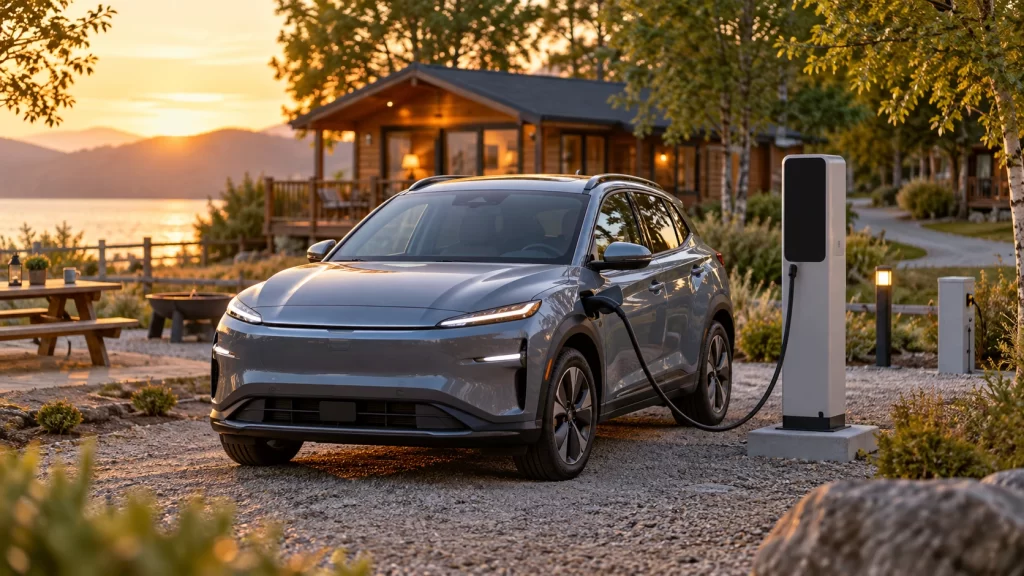
Arriving at a campsite with a low battery can turn a relaxed evening into a search for somewhere to charge. The most common electric vehicle charging mistakes at campsites start before arrival: assuming that every electrical connection can charge a car, or that a charger will be free when needed. A few checks can make the difference between charging during your stay and changing your next day’s route.
Assuming a pitch socket is an EV charger
A campsite power connection may be intended for camping equipment, even if the socket appears to fit an adapter you own. The connection, its permitted use and the way electricity is billed may all differ from a dedicated EV charging station. A physical connection is not permission to charge a vehicle.
Check the campsite’s charging policy before packing an adapter or planning to plug in at your pitch. Cars may not be charged directly from the electricity posts or cabins. The site has two charging stations outside the restaurant. Knowing that distinction in advance helps you choose where to park and how to fit charging around your stay.
Avoid running a cable from a cabin or across a pitch to reach the car unless the campsite has explicitly approved that arrangement. A cable in a shared area can also get in the way of people walking, unloading luggage or moving vehicles. If the approved charging location is away from your accommodation, plan for a short walk back after plugging in.
Treating a charger as guaranteed availability
Finding out that a campsite has EV charging is only the first step. A small number of charging points may already be occupied when you arrive, and a car can remain connected after it has enough charge. Do not base an entire journey on being able to plug in immediately.
Before travelling, ask whether the campsite requires a reservation or uses a first-come, first-served arrangement. Check how charging starts and how payment works, too. Some charging points require an app, a payment card or another method that is easier to arrange while you still have a reliable connection and time to spare.
Imagine reaching a campsite after dinner with just enough battery to get there, only to find both chargers occupied. A nearby public charger might solve the problem, but reaching it still requires range. Arriving with a practical reserve gives you room to wait, charge elsewhere or adjust the following day’s plans.
Confusing a long stay with enough charging time
An overnight stop does not automatically mean a full battery by morning. How much energy you can add depends on the charger, your vehicle, its starting battery level and how long you are actually connected. Time spent checking in, unloading or waiting for a space reduces the charging window.
Focus on the charge needed for your next drive rather than assuming you must leave at 100%. Estimate the distance to your next reliable charging stop and allow for ordinary changes in the journey, such as a detour or an extra outing. Your vehicle’s route planner or charging display can help you judge whether the available time is sufficient.
If you need a quicker top-up than a campsite charger can provide, look for a suitable public fast charger along your route. The campsite identifies fast charging in Sørlandsparken, about seven minutes away. That option is useful to know about, but it still pays to check the charger’s current availability and compatibility before relying on it.
Forgetting the details that make a charger usable
A charging point can be present yet unsuitable for your particular arrival. Confirm the connector your car uses and whether you need to bring your own charging cable. Check whether the car can reach the charger from its parking space without stretching the cable or blocking another space. If you will arrive late, find out whether you can access the charging area then.
Payment deserves the same attention. A driver who has the right cable but cannot activate the charger may face the same delay as one who found no space. Set up any required account before departure, and keep another payment method available for charging elsewhere if your route depends on it.
Charging speed can also be misunderstood. A charger’s advertised capability does not tell you exactly how quickly your car will charge throughout a session; the vehicle and its battery state affect the result. Use the information shown by your car once charging begins, then reassess your departure plan if progress is slower than expected. For more detailed information on this topic, read our guide on Why Motorhome Camping Is a Flexible Choice for Family Holidays.
Letting charging disrupt the rest of the campsite
Charging is a shared facility where one driver’s parking choice affects others. Use the designated charging space while your car is charging, follow any posted parking instructions, and move the vehicle when the session is finished if others need access. Leave cables where they will not obstruct paths or neighbouring vehicles.
It helps to fit charging into activities you already have planned. For example, you might plug in before visiting the restaurant, then check the car’s progress before settling in for the evening. That avoids an unnecessary trip across the site later and makes it easier to free the charging point once you have enough for your next drive.
The simplest way to avoid campsite charging problems is to treat charging as a separate part of the trip plan. Confirm the site’s rules, the charger’s access and payment method, and the amount of charge your next journey requires. Bring enough battery to handle a wait or an alternative stop. Those checks leave you free to enjoy the campsite without making your departure depend on a last-minute charge.